
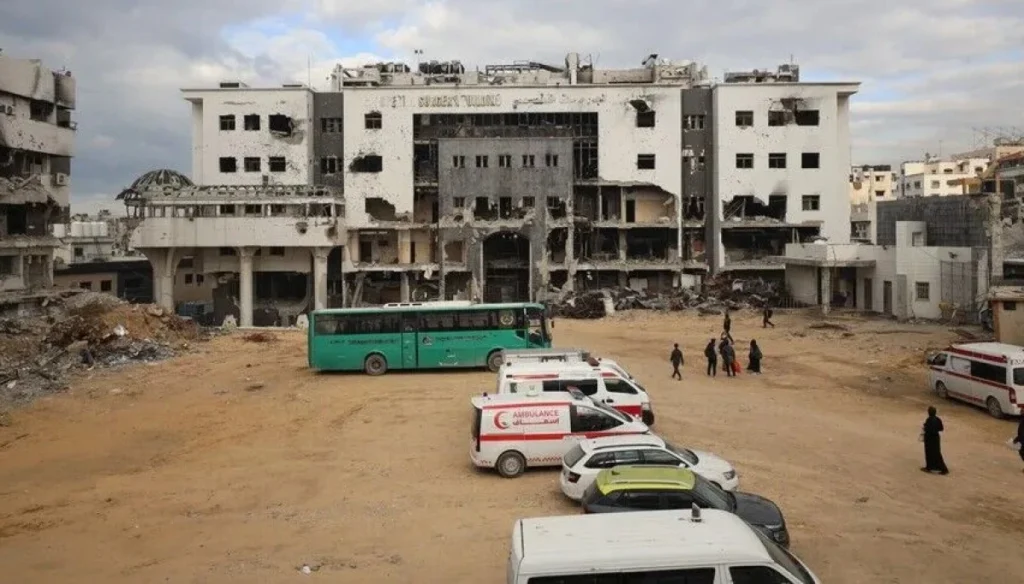
Gaza still has no hospital operating at full capacity a year after a ceasefire took effect, Physicians for Human Rights-Israel said on Thursday.
The Israeli rights organization released a report assessing the state of Gaza’s health system nearly a year after the ceasefire began in October 2025.
It said the period has not brought about a genuine recovery of the health system despite a limited increase in the number of hospitals that have partially resumed operations.
“The number of intensive care beds has practically not changed, the shortage of medicines and essential medical supplies has worsened, while thousands of patients remain deprived of life-saving treatments that are unavailable in the Strip,” the organization said.
“In October 2025, 14 of the 36 hospitals were operating partially. Nearly a year later, the number has risen to 20, but none is still capable of operating fully,” it said.
The report added that Gaza had 103 intensive care beds in October 2025, compared with only 104 in July 2026, noting that kidney dialysis services had failed to recover.
“Dialysis services were available at 17% of health facilities in October 2025, falling to 12% in July 2026, while MRI services remain unavailable in the Strip,” it said.
The World Health Organization documented at least 143 additional attacks on health care during the first seven months of the ceasefire, it said.
The shortage of medicines and medical supplies also persisted. According to data from Israel’s Coordinator of Government Activities in the Territories (COGAT), 69% of medical supplies approved for entry into Gaza between January and May 2026 did not actually enter the enclave, the organization said.
The report also highlighted the consequences of the closure of crossings and restrictions preventing Palestinians from leaving Gaza for medical treatment, saying “patients are dying while waiting for evacuation.”
“While the need for treatment is increasing, the number of people leaving for medical care is far below pre-war levels,” the report said.
Before October 2023, between 50 and 100 patients left Gaza each day to receive medical treatment, it said.
Between Oct. 10, 2025 and mid-September 2026, about 3,423 patients were evacuated abroad, a rate three to six times lower than pre-war levels despite the sharp increase in demand for treatment outside the Strip, according to the report.
The Israeli organization said that “killings, injuries and acts of genocide continue in Gaza even under the ceasefire.”
According to figures from the WHO’s Health Cluster, Israeli forces killed at least 1,422 Palestinians and injured 5,150 others between the announcement of the ceasefire and the end of September 2026, the non-profit said.
The figures, the organization said, “do not merely reflect a slow recovery of a destroyed health system.”
Milena Ansari, director of the Occupied Territories Department at Physicians for Human Rights-Israel and author of the report, said a year of ceasefire was supposed to provide Palestinians with genuine relief and recovery. “But the system remains devastated, essential medicines and supplies are not reaching Gaza in the quantities needed, and patients continue to die while being denied treatment available just a few kilometers away in the West Bank, including East Jerusalem.”
“The data show that the ceasefire has not stopped the genocide, but has only changed the way it is carried out,” Ansari added.
Habere ait etiket tanımlanmamış.




Yorumlar kapalı.